
Business Reality
Too Much Planning. When Do We Actually Execute?
Foundations matter. But not every decision needs to wait until everything is perfect.
Read article ↗EDWIN REGA / Insights
Innovation & Commercialization
Evidence-Based Insight
The technology works. Users are happy. The demo is successful. But when commercial discussions begin, progress suddenly slows down.
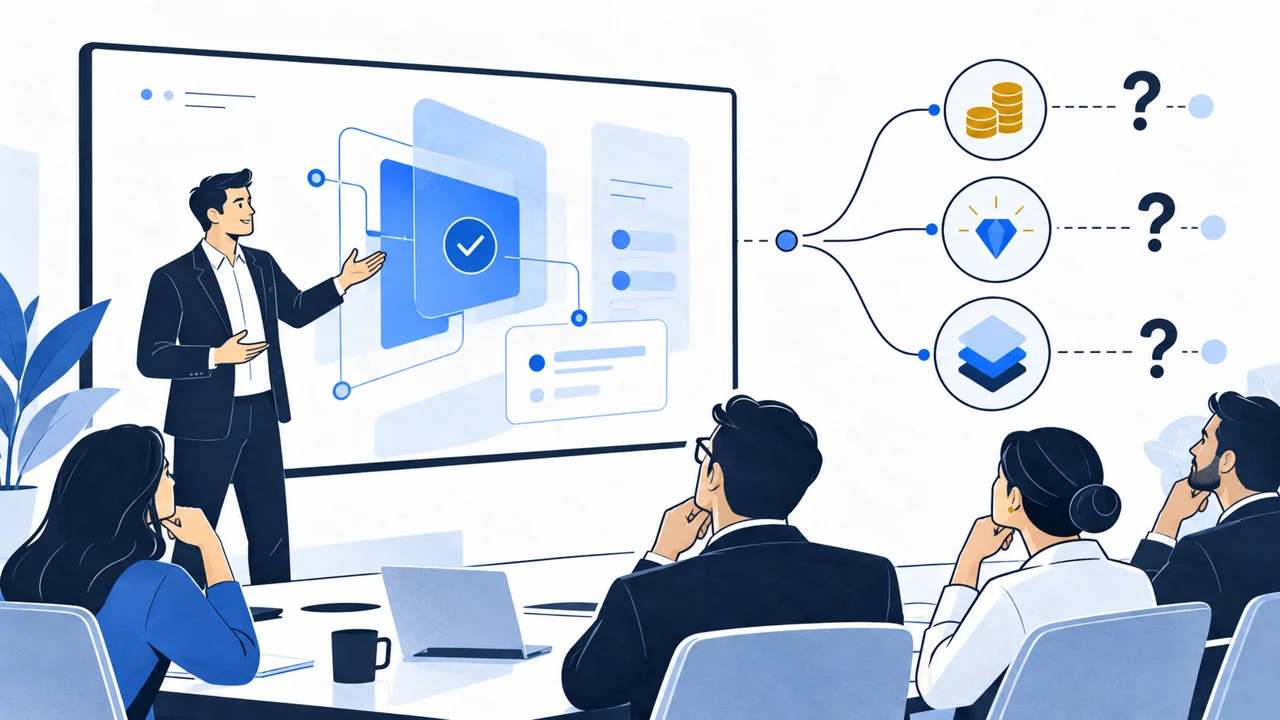
The technology works. Users are happy. The demo runs smoothly. Then the conversation turns to a contract, and the room suddenly becomes very quiet.
Calendars fill up, budget discussions remain unfinished, and the next decision requires another meeting. A proof of concept can look convincing on a screen without having a clear place in the customer's business priorities.
This is an illustrative situation, not an account of a particular project or company. The useful question is what the exercise actually established: that a system can work, or that a business deserves investment? Those questions are related. They are not interchangeable.
Technical success establishes whether an approach can deliver the required functions under the conditions tested. Commercial success requires additional answers about customers, markets, organizational priorities, and the economics of a continuing service.
Carbonell-Foulquié and colleagues group new-product decision criteria into strategic fit, technical feasibility, customer acceptance, market opportunity, and financial performance. Their study concerns innovative product development, not enterprise PoC conversion rates. [1]
My practical interpretation is to attach a clear object to the word successful. Connecting two systems does not establish customer demand, operational readiness, or an attractive relationship between revenue and cost.
Users can appreciate a solution without having purchasing authority. A process owner cares about work outcomes, a budget owner manages allocations, an economic buyer considers investment value, and a decision maker weighs organizational priorities. These responsibilities may belong to one person or several.
Teece connects business models with creating, delivering, and capturing value. Customer benefit needs a credible connection to how the provider earns revenue and profit. [2]
My application is to distinguish positive feedback, willingness to commit resources, and a purchase commitment that can proceed through the customer's actual process. All are useful evidence, but they answer different questions. Applause rarely arrives with its own budget code.
Ask who experiences the problem, who receives the benefit, who pays, and how approval works. This is not an instruction to pressure people into signing. It is a way to understand the decision path before a team adds more promises, effort, and expense.
The publisher's summary of Blank's article describes testing and revising business hypotheses through customer feedback, rather than treating the original plan as settled knowledge. [3]
My practical translation is to write down the riskiest assumptions before building a feature checklist. Is the problem important enough? Does the proposed improvement matter in real work? Is that improvement worth paying for? These are my evaluation questions, not research findings attributed to Blank.
Specify the evidence needed and how it will be collected. Compare a baseline with the test result, acknowledge the limits of the participants and environment, and agree on success measures. Customer discovery helps investigate needs; a demonstration helps examine a solution. Neither activity should be expected to answer every question.
The cost of an experiment is not the cost of an ongoing service. Infrastructure, security, integration, support, maintenance, training, and incident handling belong in a total-cost-of-ownership discussion. Manual assistance supplied by developers during a demo also needs attention when usage expands.
van Rijnsoever and colleagues examine interdependent adoption attributes, including compatibility and complexity, in consumer electronics. Their work is not direct empirical evidence about enterprise PoC commercialization. [4]
I use that perspective as a reminder to examine fit with the user's environment, not as a cost formula. A function that is easy to try may still be difficult to integrate, support, or operate reliably in everyday work.
Build cost scenarios with visible assumptions about usage, service levels, suppliers, staffing, and responsibility when something goes wrong. Avoid precise-looking numbers resting on vague expectations. A tidy spreadsheet can still contain optimism that has never been asked a difficult question.
Cooper's Stage-Gate literature supports staged evaluation and investment decisions at review points. That principle helps separate development activity from the decision to increase commitment. [5]
The following five dimensions are my practical synthesis. They are not a validated academic model, not a scoring instrument supplied by these sources, and not a guarantee of commercial success.
For each dimension, record evidence, remaining assumptions, an accountable follow-up owner, and the decision required. Resist hiding uncertainty inside one average score. Strong results on easy-to-test aspects can conceal a serious weakness elsewhere.
Use the assessment to choose Go, Refine, Hold, or Stop. These are practical decision labels in my framework: proceed, improve a particular assumption, wait for a prerequisite, or stop additional commitment. Record the reasoning and conditions for reconsideration so the decision does not become merely another slide heading.
A PoC can create value by revealing a risk that should not yet be accepted, a weak customer need, or service economics that do not hold together. Learning those limits before increasing investment is useful evidence, not automatically a failure by the team.
A successful demonstration still deserves recognition. Place it in context as one part of the evidence, then add customer validation, operational readiness, and a commercial path before making a business decision.
A PoC establishes that something is possible.
Commercialization establishes that it is worth pursuing as a business.
The purpose of innovation is not to accumulate successful demonstrations.
It is to improve the chances of building a business that can actually endure.
Given everything we have learned, is this business worth taking forward?
Pilar Carbonell-Foulquié, Jose L. Munuera-Alemán, Ana I. Rodríguez-Escudero (2004). Criteria employed for go/no-go decisions when developing successful highly innovative products. Industrial Marketing Management, 33(4), 307–316 / Elsevier.
Read source ↗DOI: 10.1016/S0019-8501(03)00080-4 ↗New-product evaluation criteria; not evidence of enterprise PoC conversion rates.
David J. Teece (2010). Business Models, Business Strategy and Innovation. Long Range Planning, 43(2–3), 172–194 / Elsevier.
Read source ↗DOI: 10.1016/j.lrp.2009.07.003 ↗Conceptual foundation for value creation, delivery and capture.
Steve Blank (2013). Why the Lean Start-Up Changes Everything. Harvard Business Review, May 2013.
Read source ↗Practitioner perspective; publisher summary checked for hypothesis testing and customer feedback.
Frank J. van Rijnsoever, Daan van Hameren, Peter F. G. Walraven, Jaco P. van Dijk (2009). Interdependent technology attributes and the diffusion of consumer electronics. Telematics and Informatics, 26(4), 410–420 / Elsevier.
Read source ↗DOI: 10.1016/j.tele.2009.01.001 ↗Consumer-electronics context; not direct evidence about enterprise commercialization.
Robert G. Cooper (2010). The Stage-Gate Idea to Launch System. Wiley International Encyclopedia of Marketing / Wiley.
Read source ↗DOI: 10.1002/9781444316568.wiem05014 ↗Staged investment review; the article’s five dimensions are the author’s synthesis.
Business Reality
Foundations matter. But not every decision needs to wait until everything is perfect.
Read article ↗Office Chronicles
Repeated work can look like a productivity problem when the real opportunity lies in how the organization coordinates.
Read article ↗