Lessons & Perspectives
Saying No Is Also Part of Strategy.
Not every good idea needs to be pursued. And not every project that starts needs to be completed.
Read article ↗EDWIN REGA / Insights
Lessons & Perspectives
Six years. Five different roles. One continuous learning journey.
Six years at the same company might sound like a fairly straightforward journey.
For me, however, it has shown that experience does not always have to come from changing employers. Sometimes the opportunity to see business from a different angle comes through changing responsibilities, challenges, and roles within the same organization.
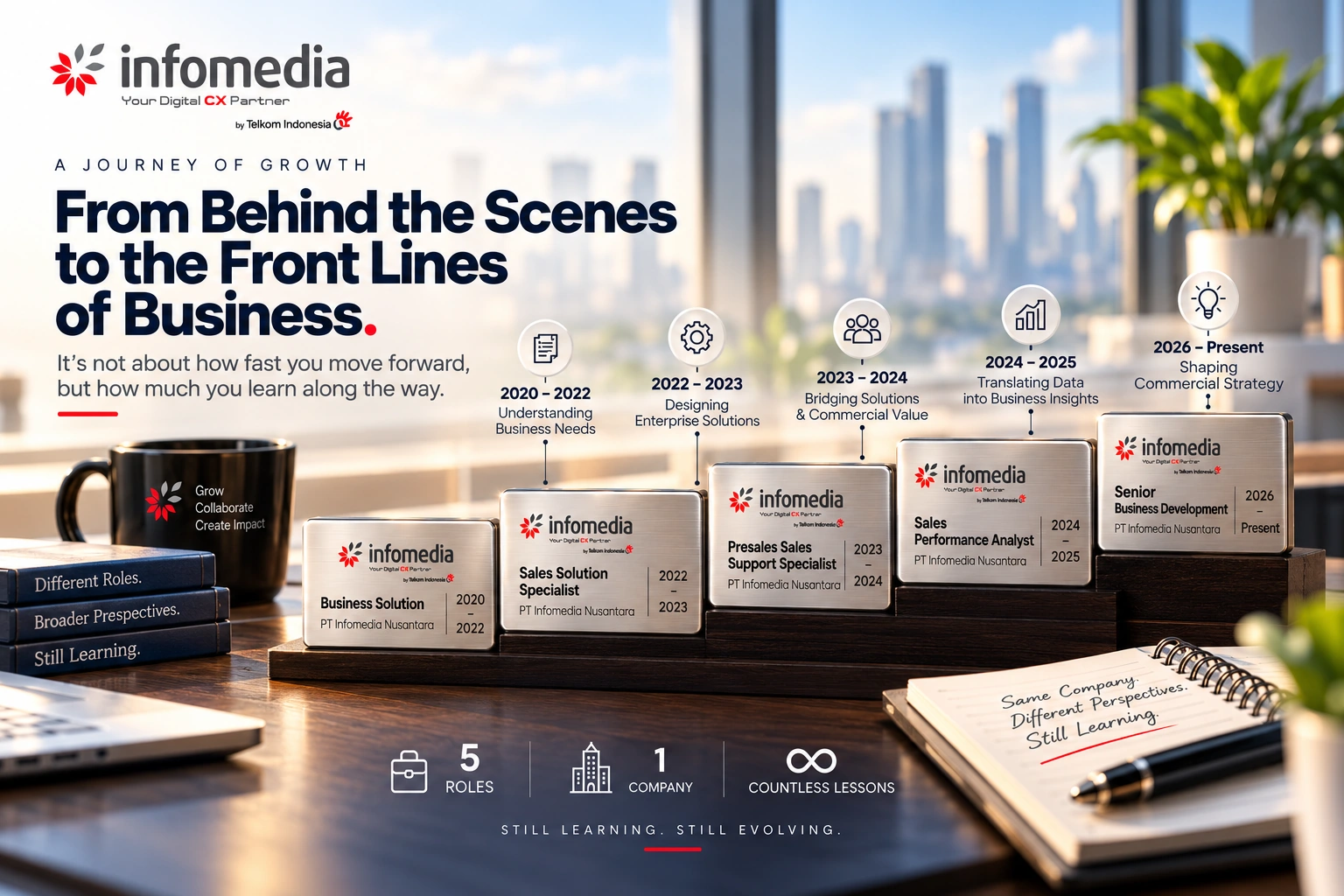
Since 2020, I have had the opportunity to work in five different roles at PT Infomedia Nusantara, part of Telkom Indonesia Group.
The journey has taken me from understanding business needs and designing solutions to supporting sales, analyzing performance, and now contributing to business development and commercial strategy.
Each role brought different responsibilities.
Each transition required adjustment.
And each experience offered a new perspective on how a business actually works.
Same company. Different roles. A new perspective each time.
My journey began in Business Solution.
At this stage, I started learning how customer needs are translated into business solutions.
I learned that understanding customers is not only about listening to what they request. It also means trying to understand their context, operational challenges, and intended outcomes.
A solution may look appealing from a technology perspective. Without understanding the business problem it is meant to address, however, the value it offers may be less relevant.
This was where I began to appreciate the importance of connecting customer needs with the capabilities of available solutions.
Lesson one: before discussing a solution, first understand the problem that needs to be solved.
My next role brought me closer to designing solutions for enterprise needs.
While my earlier focus had been understanding business requirements, I now began to see how those requirements could become a more structured solution approach.
I learned to consider the scope of a requirement, the fit of a solution, and how a proposal could benefit the customer.
This was also where I increasingly realized that a good solution needs more than a comprehensive feature list.
It must be relevant, explainable, and valuable in ways that the people who will use it can understand.
The experience helped me develop a more systematic way of connecting business needs with solution design.
Lesson two: the best solution is not necessarily the most complex one, but the one most relevant to the business need and objective.
Moving into the Presales Sales Support Specialist role broadened my perspective again.
I began to see business from a position closer to sales activities and commercial considerations.
Even a good solution needs to be communicated appropriately so that customers understand its value.
Here, I learned that presales involves more than explaining products or preparing supporting sales materials.
It requires building a bridge between customer needs, the proposed solution, and the business considerations behind an offer.
I also developed a stronger appreciation for collaboration across roles in supporting the sales process.
Ultimately, a solution does not only need to work.
It also needs to be positioned as something valuable to the customer.
Lesson three: a solution's value depends not only on its capabilities, but also on how clearly its business benefits can be explained.
The Sales Performance Analyst role brought a significant change in perspective.
After several years looking at business through customer needs, solutions, and sales support, I had the opportunity to study it through data and performance.
I began to see how business activities become indicators, trends, and information that can support evaluation.
This experience reinforced my understanding that numbers should not end their journey in a report.
Data needs to provide context.
Why has performance changed?
What explains whether a target has been achieved?
Which areas need attention?
And what can we learn to support the next decision?
I learned that a useful dashboard is not simply one that displays many indicators. It helps its users understand business conditions and decide what to do next.
Lesson four: data becomes more valuable when it explains business conditions and supports decisions, rather than merely displaying numbers.
In 2026, I had the opportunity to take on a Senior Business Development role.
It has given me a broader perspective on the connections between market needs, solution development, business opportunities, and commercial strategy.
In earlier roles, I had learned about understanding needs, designing solutions, supporting sales, and analyzing performance. Now I have the opportunity to see how those perspectives connect.
I am increasingly learning that business development involves more than finding new opportunities.
There are questions to answer before an opportunity is truly worth pursuing.
Is the market need sufficiently clear?
Does the proposed solution offer relevant value?
Can the business model work?
Is the organization ready to deliver it?
And how can the opportunity contribute sustainably?
These questions have helped me see business development not simply as a search for growth, but also as a process of evaluating choices and setting priorities.
Of course, my journey in this role is still unfolding.
There is much more for me to learn, particularly about connecting strategic perspectives with the realities of business execution.
Lesson five: business growth is not only about finding more opportunities, but also about understanding which opportunities are genuinely worth developing.
Looking back, I realize that these five roles are not separate, disconnected experiences.
Each has built a perspective that complements the others.
| Journey | Perspective Learned |
|---|---|
| Business Solution | Understanding Business Needs |
| Sales Solution Specialist | Designing Enterprise Solutions |
| Presales Sales Support Specialist | Connecting Solutions with Commercial Value |
| Sales Performance Analyst | Turning Data into Business Insights |
| Senior Business Development | Shaping Commercial Strategy |
From working behind the scenes to moving closer to the front lines of business development, I have had the opportunity to see how different organizational functions connect.
These experiences have also deepened my appreciation of the complexity behind a business decision.
Something that looks simple from one perspective may not be simple from another.
A commercially attractive opportunity may require greater operational readiness.
A technically strong solution may not yet have the right business model.
And a positive performance indicator may not tell the whole business story.
The more perspectives I encounter, the more I recognize that good business decisions require understanding across functions.
There was a time when I thought about career development mainly in terms of how quickly someone moved into the next position.
This journey has given me a different perspective.
Growth also means broadening the way we think.
Learning to understand problems we had not previously noticed.
Listening to different points of view.
And recognizing that what we know today may not be enough to address the next challenge.
Five roles in six years does not mean I have mastered every aspect of business.
If anything, each transition has revealed more things I do not yet know.
To me, that is one of the most interesting parts of learning.
The more perspectives you gain, the more you realize there is still so much to learn.
I am grateful for the opportunity to learn through different roles within one organization.
Each stage has brought its own challenges and lessons.
There has been a time to understand.
A time to design.
A time to support.
A time to analyze.
And now, an opportunity to contribute more deeply to business development.
I do not see this journey as a story about how quickly someone reaches a position.
For me, it is about how different experiences can shape a broader perspective.
Ultimately, growth is not only about how far we move forward, but also about how many perspectives we gain along the way.
Same company.
Different roles.
Broader perspectives.
Still learning. Still evolving.
Edwin Rega
Business & Technology Consultant
Thoughts on Business, Technology & Continuous Learning.
Lessons & Perspectives
Not every good idea needs to be pursued. And not every project that starts needs to be completed.
Read article ↗Business Reality
Foundations matter. But not every decision needs to wait until everything is perfect.
Read article ↗